Deck Replacement in Roswell & North Atlanta
A lot of North Fulton decks went up in the 1980s and ’90s, nailed to the house with no flashing and set on posts buried straight in red clay. When the framing underneath is done, new boards on top won’t save it. We tear the old deck off, check what’s worth keeping, and build a replacement that meets today’s code and fits the way you actually use the yard.
Replace or repair? Start with the structure, not the boards.
Grey, splintered decking looks bad, but it’s the least important thing on a deck. Surface boards can be swapped. What decides between repair and replacement is what holds those boards up: the ledger, the joists, the beams, the posts and the footings.
Signs it’s time to replace
If the frame passes but the boards don’t, deck resurfacing puts new boards on the old structure for less. If you only want the deck gone, see deck removal.
- A ledger with no flashing, or water staining and soft wood where the deck meets the rim of the house. That’s the connection that lets go when decks collapse.
- Rot spread across many joists, not one or two. If an awl sinks into a third of the framing, sistering stops making sense.
- Posts buried directly in the ground or sitting on a block on top of the soil, with no real footing.
- Rusted hangers and fasteners. Modern treated lumber is more corrosive than the old stuff, and plain steel or lightly galvanized hardware from an earlier build won’t last against it.
- Railings that move when you lean on them, or guards under 36 inches on a deck more than 30 inches off the ground.
- A layout that never worked: too narrow for a table, stairs in the wrong spot, no shade. If you’re going to rebuild the bones anyway, it’s the cheapest time to fix the design.
If you’re on the fence, run your deck through our repair-or-replace checklist. It walks through the same questions we ask on site and gives you a straight answer about which direction you’re leaning.
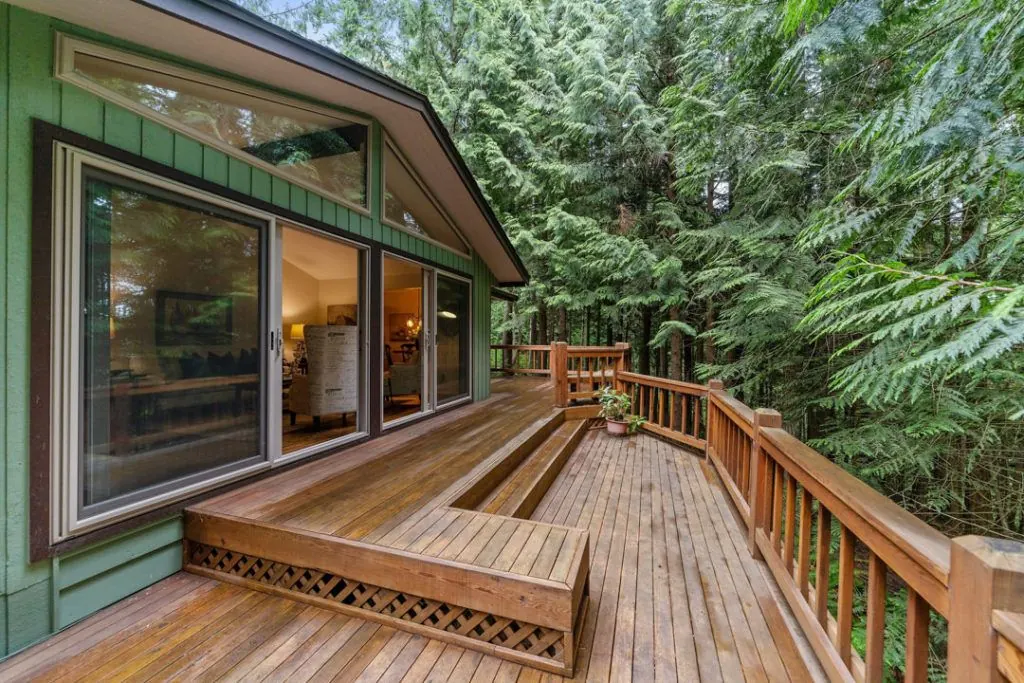
From tear-off to final inspection.
A typical replacement on a single-level deck takes a couple of weeks of site work once the permit is issued. Weather and inspection scheduling move that around more than anything we do.
Site visit & measure
We pull a few boards, probe the framing, look at the ledger from underneath, and dig beside a post or two to see what the footings really are.
Design, permit & HOA
We draw the new deck, submit it to the city (Roswell, Alpharetta, Johns Creek, Milton and Dunwoody each permit their own), and prepare the HOA package if your neighborhood requires one.
Tear-off & haul-away
Railings, boards, framing and old posts come off and leave on our trailer. Old treated lumber goes to disposal, never into a backyard burn pile.
Footings & ledger
New or verified footings on undisturbed soil, a ledger bolted to the house band with flashing and membrane behind it, or a freestanding beam where the wall can’t take a ledger.
Frame, deck & rail
Joist tape on the framing, the decking you chose, then guards and stair rails. Inspections happen at the stages the city calls for, and we close out the permit.
Rebuilding on existing footings: sometimes yes, often no.
Homeowners ask us this a lot, because reusing footings sounds like an easy saving. Sometimes it is. If the old footings are concrete, sized right, deep enough, sitting on undisturbed soil and in the right place for the new framing, we’ll keep them and the inspector will usually agree.
In practice, older decks around Roswell and Alpharetta often fail one of those tests. We find posts set in a bag of concrete poured straight into a post hole, pads that sat on backfill from when the house was built, and footings spaced for a joist layout nobody would build today. North Fulton’s red clay holds a footing well when it’s dug into firm native soil; it doesn’t when the footing sits in the loose fill around a foundation. If a new deck is a different size, higher, or carrying a future roof or hot tub, the old footings almost never line up anyway.
The ledger gets the same scrutiny. On a replacement we take the siding off along the ledger line, look at the house rim joist behind it, and replace any rotted sheathing before the new ledger goes on. If the house is brick or stone veneer, a ledger can’t hang on the veneer, so we build the deck freestanding with its own beam and posts along the house side.
What deck replacement costs in North Atlanta
These are typical 2026 installed ranges for our area, not a quote. Height, access, slope, stairs and the condition of the house wall all move the number.
- Pressure-treated pine: $35–55 per sq ft
- Cedar: $45–65 per sq ft
- Capped composite: $55–85 per sq ft
- PVC: $65–95 per sq ft
- Ipe: $75–110 per sq ft
- Demolition and haul-away of the old deck: $5–10 per sq ft
- Railing per linear foot: wood $35–60, aluminum $70–110, cable $110–180, glass $150–250
For a sense of scale: replacing a 16×20 ft (320 sq ft) deck in pressure-treated pine works out to roughly $11,200–17,600 for the deck itself, plus $1,600–3,200 to tear off the old one, plus around 50 feet of railing. The same deck in capped composite runs about $17,600–27,200 before demo and rail. Plug your own size and material into the deck cost calculator, and use the board calculator if you want to check material counts. Railing choices are compared on our railing styles page.
Replacement is a chance to change the plan
Once the old deck is gone, size, height, stairs and shape are all open. Common upgrades on a replacement are a wider footprint for a real dining table, stairs moved to land near the patio or driveway, framing sized to carry a future screened porch or pergola or roof, and a switch from wood to low-maintenance decking. Our deck design process and the custom decks page go deeper on layouts and materials.
We replace decks across Roswell, Alpharetta, Johns Creek, Dunwoody and north Atlanta. Whoever you hire, check their Georgia residential contractor license on the Secretary of State’s licensing lookup (it’s required for residential jobs over $2,500) and ask for a current certificate of insurance before work starts.
Related guides: deck replacement cost in Atlanta · how a deck ledger board should attach · deck permits in North Fulton · the best wood for a new deck
Questions about tearing out an old deck.
How much does deck replacement cost?
In North Atlanta, typical installed ranges run $35–55 per sq ft for pressure-treated pine up to $55–85 for capped composite and $75–110 for ipe, plus $5–10 per sq ft to demolish and haul away the old deck and $35–250 per linear foot of railing depending on style. Those are ranges, not a quote; a site visit pins it down.
Can you replace just the boards and keep the frame?
Yes, if the framing, ledger and footings check out. Re-decking a sound frame is a legitimate, cheaper option. We won’t put new boards on a frame we expect to fail before the boards do, and composite boards may need joists closer together than an old wood deck was framed.
Do I need a permit to replace a deck in Roswell or Alpharetta?
Generally yes. Replacing the structure of a deck is treated as new construction by North Fulton cities, so expect drawings, a building permit and inspections. Simple board-for-board resurfacing may be handled differently; we confirm with the city before quoting.
How long does a deck replacement take?
Permitting and any HOA review usually take longer than the build. Once approved, a single-level replacement is typically one to three weeks on site, depending on size, height, stairs, railing type, weather and inspection timing.
Is it worth replacing a wood deck with composite?
If you’re tired of washing and re-staining every couple of years, often yes. Composite costs more up front but skips the staining cycle. The framing underneath is still treated lumber, so it gets the same joist tape and flashing either way.
Stop staring at that tired old deck. Let’s draw something better.
Free in-home consultation. Honest material guidance. A clear, fixed-price quote you can take to the bank — usually within 48 hours of our visit.
Mon–Fri 7a–6p · Sat 8a–4p · Real local crews · No call centers