Deck Resurfacing & Refinishing in Roswell & North Atlanta
Deck resurfacing means keeping the structure you already paid for and replacing what you walk on. If the framing under a tired deck is still solid, new boards (wood or composite) on the old frame can cost far less than a full tear-off. If the boards themselves are still sound, sanding and refinishing them may be all it takes. We check the frame first, then tell you which of the two makes sense.
Two ways to bring a deck back: resurface or refinish
People use the words loosely, so here’s how we use them. Both start from the same question: is the structure under the boards good for another fifteen or twenty years?
Deck resurfacing: new boards on the existing frame
The old decking, stair treads and usually the railings come off. The ledger, joists, beams, posts and footings stay. We repair what needs it, tape the tops of the joists, and lay new decking. That can be fresh pressure-treated pine, cedar, or a switch to capped composite or PVC so you’re done with staining. Fascia boards and stair risers are usually replaced at the same time so the whole deck matches.
Deck refinishing: sand and recoat the boards you have
When the boards are grey, rough or blotchy but not rotten, cupped or badly split, a deck refinishing job brings them back. That means cleaning, stripping any old peeling finish, brightening, sanding raised grain and splinters, swapping the handful of boards that are past saving, re-setting popped nails, then a new coat of stain. It’s the same prep sequence as our deck staining and sealing service, with more sanding and board work.
Not sure which side your deck falls on? Our repair-or-replace checklist walks through the same questions we ask on site.
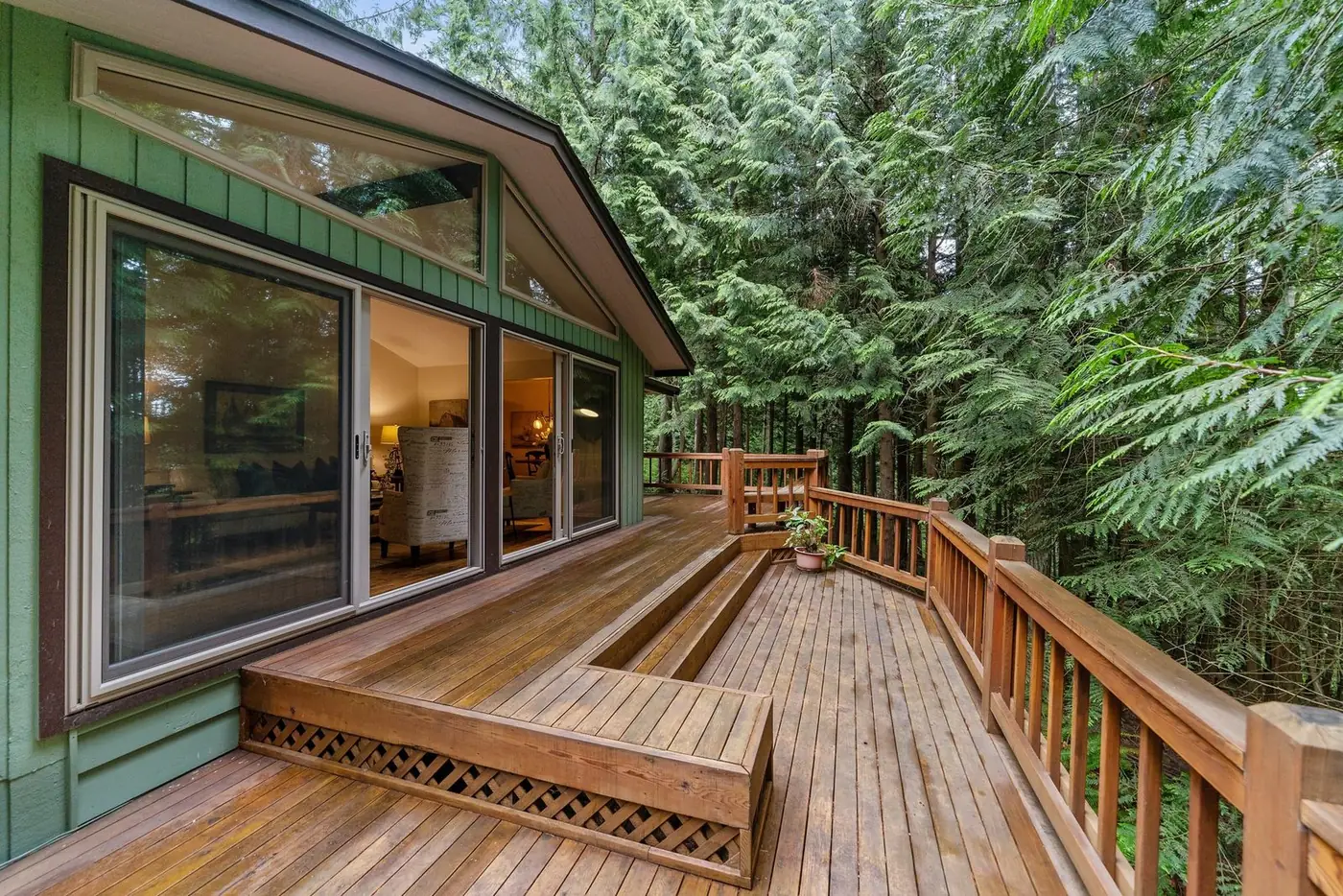
What we look at before quoting new boards.
New decking on a failing frame is money spent twice. Before we price a resurface, we get underneath the deck and look at the parts that actually hold it up.
Ledger & flashing
Is the ledger bolted or screwed to the house band, not just nailed? Is there flashing over it? Water stains or soft wood behind the ledger mean the boards come off and we look at the ledger connection before anything else.
Joists & hangers
We probe joist tops and ends with an awl, look for rusted or half-nailed hangers, and measure joist spacing. One or two soft joists can be sistered; rot spread across many joists usually means deck replacement instead.
Beams, posts & footings
Posts should sit on concrete footings, not be buried in the clay, and beams should bear properly on them. We dig beside a post or two when we can’t see what’s there.
Joist tape & spacing
Before new boards go down, we cover joist and beam tops with joist tape so screws and trapped water don’t rot the frame from the top down. Our flashing and joist tape guide explains why it matters.
Resurfacing with composite: check the joist spacing
Switching an old wood deck to composite is the most common resurfacing job we’re asked about, and it has one catch. Many older decks were framed with joists 24 inches apart, which worked for thick 2×6 wood decking. Most composite and PVC boards call for joists closer together, typically 16 inches on center for boards running square to the joists and tighter (often 12 inches) for diagonal patterns. The exact number is in each manufacturer’s install guide, and it’s tied to their warranty.
If your joists are too far apart, we add joists between the existing ones (or block between them) before the new boards go on. That adds cost, but it’s still usually well short of a full tear-off. Our deck joist spacing guide covers the details, and the best composite decking guide compares the main board lines if you’re choosing one.
Composite also changes the look of the edges. Grooved boards with hidden fasteners leave a clean surface with no screw heads, and matching fascia covers the rim joists. Railings are a separate decision: some homeowners keep sound wood rails and paint them, others switch to aluminum or composite rail systems so the whole deck stops needing stain.
Deck refinishing in Georgia’s climate
North Atlanta is hard on wood. High humidity, summer heat on south- and west-facing decks, heavy oak and pine canopy, and a spring pollen season that coats everything yellow all speed up graying and mildew. A deck that was refinished three summers ago and never touched since is often fuzzy, grey and splintered by now.
Refinishing works when the wood itself is still sound. Signs it’s a good candidate:
- Boards are flat or only slightly cupped, and screws or nails still hold.
- Graying and roughness are on the surface; a screwdriver doesn’t sink in.
- Only a few boards are split or soft, so swapping them is reasonable.
- You’re happy with the layout and the railings are solid.
Signs it isn’t: widespread cupping, boards that flex between joists, lots of checking that catches socks and bare feet, or a thick, peeling solid stain that would take more stripping than the boards are worth. At that point new boards often cost less over ten years than repeated stripping and sanding.
Timing matters for the refinish itself. We avoid the heavy pollen weeks of spring and schedule when the wood can dry out after cleaning, usually late spring or early fall. The best deck stain guide and our stain vs paint guide help you pick the finish.
What deck resurfacing costs in North Atlanta
These are typical 2026 installed ranges for our area, not a quote. The frame’s condition, deck height, stairs and access move the number more than anything else.
- Resurfacing with capped composite or PVC: a typical range of roughly $30–55 per sq ft for new decking, fascia and stair treads on a sound existing frame, before railings. That’s roughly the board share of a new composite deck, since the framing is already there.
- Resurfacing with new pressure-treated pine: typically about $12–20 per sq ft for new boards on a sound frame, the same planning range our repair-or-replace tool uses. Ask for both prices if you’re undecided.
- Railing, if replaced: per linear foot, wood $35–60, aluminum $70–110, cable $110–180, glass $150–250.
- Frame repairs: sistered joists, added joists for composite spacing, new hangers or ledger work are priced on top, after we’ve looked.
- Sand-and-refinish of existing boards: roughly $2–5 per sq ft including wash and prep, from our staining range. Heavy sanding, stripping or many board swaps push it to the top of that range or beyond.
For scale: a 300 sq ft deck resurfaced in composite lands very roughly between $9,000 and $16,500 before railings and any frame repairs, while refinishing the same deck’s existing boards is roughly $600–1,500 for the floor. Compare that with a full replacement on our deck replacement page, or run your own numbers in the composite deck cost calculator.
How long will a resurfaced deck last?
The new boards are only as good as the frame under them. Composite boards are made to last for decades, but most decks are still framed with pressure-treated lumber, and if that frame is already twenty years old you should plan on it, not the boards, being the limit. That’s why we’re picky about the frame check and why joist tape is standard on every resurface. Our guide on how long a deck lasts breaks down lifespans by material and by part.
Permits vary. A board-for-board resurface with no structural changes may be handled differently from new construction, while adding joists, changing the ledger or rebuilding stairs can bring in a permit and inspection. We confirm with the city before quoting.
Deck resurfacing in Roswell, GA
Roswell has a lot of decks from the 1980s and 1990s whose boards are worn out but whose framing may still have years left, especially decks that were built with flashing and real footings. Those are the best candidates for resurfacing. On shaded lots near the Chattahoochee and Big Creek, we look hardest at joist tops and the ledger, because damp boards hide rot underneath. If the frame passes, new boards cost far less than a rebuild. If it doesn’t, we’ll show you what we found and price a replacement alongside.
We resurface and refinish decks in Roswell, Alpharetta, Johns Creek, Milton, Sandy Springs, Dunwoody, Marietta, Woodstock and north Atlanta. If you’re searching for deck resurfacing near me or deck refinishing near me anywhere in North Fulton, send us a few photos and the rough size and we’ll tell you which route looks right.
Related: deck repair · pressure-treated wood decks · deck stain calculator
Questions about resurfacing a deck.
How much does it cost to resurface a deck?
In North Atlanta, resurfacing a sound frame with capped composite typically runs roughly $30–55 per sq ft before railings, with new wood boards costing less. Sanding and refinishing existing boards is roughly $2–5 per sq ft. Frame repairs are extra. These are typical ranges, not a quote.
Can you put composite decking on an old wood frame?
Yes, if the frame is sound and the joists are close enough together for the board you choose, often 16 inches on center. If they’re 24 inches apart we add joists first. A frame with widespread rot or a bad ledger should be rebuilt, not covered.
Is it cheaper to resurface or replace a deck?
Resurfacing is usually cheaper because the footings, posts, beams and joists stay. It stops being the better deal when the frame needs so much repair that you’re rebuilding it anyway, or when you want a different size or layout.
What is the difference between deck resurfacing and refinishing?
Resurfacing replaces the deck boards with new wood or composite on the existing frame. Refinishing keeps the boards and restores them: clean, strip, brighten, sand, replace a few bad boards and re-stain.
Do I need a permit to resurface a deck?
It depends on the city and the scope. Board-for-board replacement with no structural changes is often treated differently from new construction, but structural repairs, stair rebuilds or ledger work may need a permit. Check with your permit office; we confirm before quoting.
Can resurfacing be done over the old deck boards?
We don’t recommend it. Laying new boards over old ones traps water, hides rot and puts screws into decking instead of joists. The old boards come off so the frame can be inspected and taped first.
Stop staring at that tired old deck. Let’s draw something better.
Free in-home consultation. Honest material guidance. A clear, fixed-price quote you can take to the bank — usually within 48 hours of our visit.
Mon–Fri 7a–6p · Sat 8a–4p · Real local crews · No call centers