Deck Board Calculator
Work out how many deck boards to buy, which board length wastes the least, how many joists go underneath and how many screws or hidden clips hold it all down.
Calculating…
How the decking calculator counts boards
Counting boards by square footage alone can leave you short. This calculator works the way a carpenter lays out a deck, row by row:
- Rows. Each row covers the board’s actual width plus the gap. A 5½-in. board with a 3⁄16-in. gap covers 511⁄16 in., so a 12-ft-deep deck needs 26 rows. We round up, because the last row along the edge still needs a board even if it gets ripped narrower.
- Linear feet. Rows times the deck length gives total linear feet. Your waste allowance goes on top. A diagonal layout adds another 15%, because every board gets angle-cut at both ends.
- Board count. For straight layouts, the calculator also checks whether the cuts actually work. On a 14-ft deck, a 16-ft board leaves a 2-ft offcut you can’t use, so you need one board per row no matter what the linear-foot math says. The board-length table shows which length wastes the least for your size.
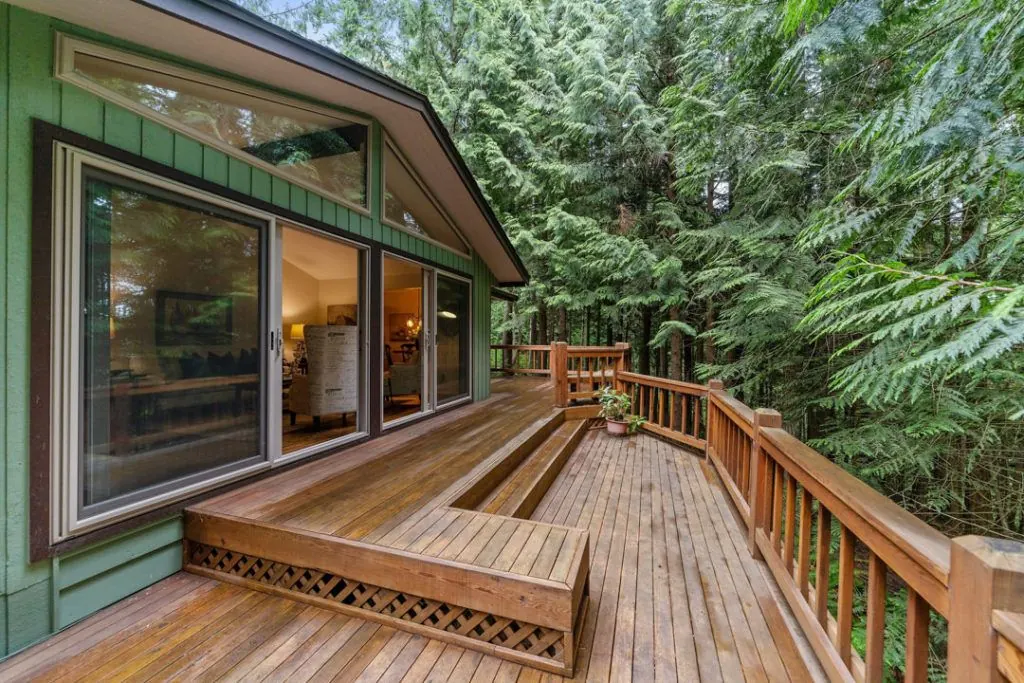
Built-in benches, steps and picture-frame borders like the ones in this photo use extra boards and extra cuts that a simple rectangle doesn’t. Count them separately and add them to the calculator’s total.
Deck material: joists and fasteners
Joists run out from the house and sit at your chosen spacing along the deck’s length, plus one at the end. Wood decking usually goes on joists at 16 in. on center. Most composite and PVC boards also want 16 in. for straight runs and 12 in. on a diagonal. Check your specific board’s install guide, because the warranty depends on it. To check whether those joists can actually span the depth, use the joist span calculator.
The deck screw estimate assumes two screws per board at every joist crossing, plus 5% spare. Hidden fastener systems use about one clip per crossing, with starter clips or face screws at the first and last rows. Screws come in boxes of different counts, so check the number printed on the box when you buy.
Georgia-specific tips
- Wet pressure-treated boards shrink. PT decking from the yard is often still wet. Many builders install it tight or with a very small gap and let it open up as it dries over a Georgia summer. Kiln-dried (KDAT) boards get the full gap from the start.
- Composite moves with heat. Dark composite in full afternoon sun gets hot and expands lengthwise. Leave the end gaps your board maker specifies, and avoid long runs butted tight against the house.
- Ventilation matters. Low decks over damp clay need airflow under the boards. That is one reason why ground-level composite decks are framed with care to stay off the soil.
Related guides
- Deck board spacing: the right gap for wet pressure-treated, kiln-dried and composite boards, and how joist spacing fits in.
- Trex vs TimberTech: comparing the two best-known capped composite brands before you buy boards.
- Best wood for decks: pressure-treated pine, cedar and ipe compared for Georgia weather.
For the framing, hangers, posts and concrete as well as the boards, use the deck material calculator.
Planning numbers only. This gives you a material list to plan and price with. Border boards, stairs, fascia, beams and posts aren’t included. Always follow the manufacturer’s gap and joist-spacing requirements for the board you choose.
Would you rather skip the lumber run? See our composite decks and custom decks pages, or try the deck cost calculator for an installed price.
Deck board questions
How many deck boards do I need for a 12×12 deck?
With 5½-in. boards and a 3⁄16-in. gap, a 12×12 deck has 26 rows of 12-ft boards. Twelve-foot boards cover each row with no joints, so 26 boards is the minimum. Buying 28 or 29 gives you room for a bad board or a miscut.
How much waste should I add for decking?
About 5–10% for a simple straight-laid rectangle. Use 10–15% for decks with angles, picture-frame borders or lots of cuts around posts. Diagonal layouts need more again, which is why the calculator adds 15% on top for them.
How many screws per square foot of deck?
With 5½-in. boards on joists at 16 in. on center and two screws per crossing, plan on roughly 3½ screws per square foot, or about 350 per 100 sq ft. At 12 in. on center, that rises to about 4½ per square foot.
Are longer deck boards better?
Only when they match your deck length. A 20-ft board on a 20-ft deck means no butt joints, which looks cleaner and lasts better. On a 14-ft deck, the same board leaves a 6-ft offcut. Pick the length that divides your deck evenly. The comparison table does that check for you.
Stop staring at that tired old deck. Let’s draw something better.
Free in-home consultation. Honest material guidance. A clear, fixed-price quote you can take to the bank — usually within 48 hours of our visit.
Mon–Fri 7a–6p · Sat 8a–4p · Real local crews · No call centers