Best Composite Decking for Georgia Decks: Tiers, Brands and Cost
The best composite decking for most North Atlanta homes is a capped board from a mid or premium line, in a light-to-medium color, from a brand your installer can source and service locally. Brand matters less than the tier, the cap, the color and how well the frame underneath is built, and a capped composite deck here typically runs $55–85 per square foot installed.
- Buy capped composite. Uncapped first-generation boards are the ones that faded, stained and grew mold.
- Every major brand sells a good / better / best ladder. Compare tier to tier, not logo to logo.
- In Georgia sun, color is the biggest comfort decision: dark boards get hot enough to bother bare feet.
- Warranties differ by line and change over time, so check the current warranty for the specific line you’re quoted.
- Typical North Atlanta installed cost: $55–85 per sq ft for capped composite and $65–95 for PVC.
What makes the best composite decking?
“Best” lists online usually rank brands as if one board wins everywhere. It doesn’t. The rankings below are our practical judgment as builders, not lab testing, and the board that suits a shaded, low deck in a wooded Milton lot is not the one that suits a sun-baked pool deck in Alpharetta. When we help a homeowner choose, we look at five things in this order:
- The cap. Whether the board has a protective polymer shell, and on how many sides.
- The tier. Entry, mid or premium within a brand’s range, which drives grain, color depth, scratch resistance and warranty length.
- The color. Light, medium or dark, which in Georgia decides how hot the deck gets in July.
- The site. Sun or shade, height above the ground, airflow and how much leaf litter and pollen land on it.
- Local supply. Whether you can get matching boards, fascia, stair treads and fasteners from an Atlanta-area supplier now and for repairs later.
Get those right and almost any major brand will give you a deck that looks good for decades. Get them wrong and even a premium board will disappoint.
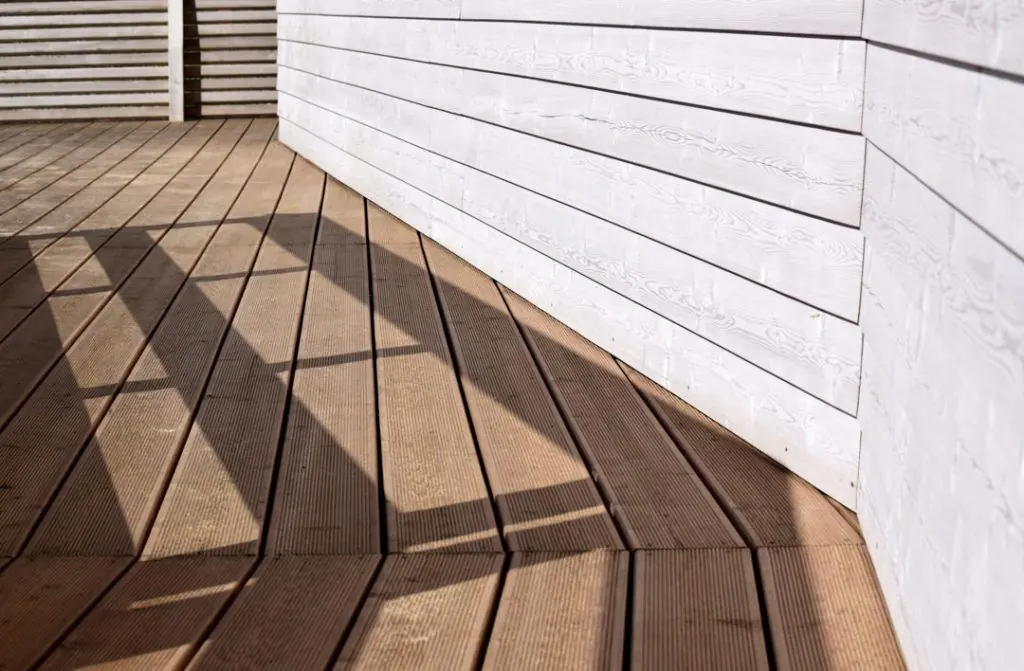
Capped vs uncapped composite decking
Composite decking is a blend of wood fiber and plastic. Early boards from the 1990s and 2000s were a single solid mix with no outer layer. In humid climates like ours they had well-known problems: the wood fiber at the surface soaked up water, food and leaf tannins stained them, they faded unevenly, and mold grew on and into the surface. Many of those decks are still around North Fulton, and they’re a big reason some homeowners distrust composite.
Modern boards are capped: a dense polymer shell is bonded over the composite core. The cap is what resists staining, scratching, fading and mold. The core gives the board its strength and weight.
Three-sided vs four-sided capping
Some boards are capped on the top and both edges, with the underside left as exposed core. Others are capped on all four sides. On a high, sunny, well-ventilated deck, three-sided capping performs well because the underside rarely stays wet. On a deck sitting low over damp red clay, under heavy tree cover, or over a patio where moisture lingers, four-sided capping or PVC is worth the premium. Cut ends are uncapped on every board, which is why good installers keep ends off standing water.
Is uncapped composite ever worth buying?
A few budget uncapped boards are still sold. They can be fine for a small, sunny, elevated platform where looks don’t matter much, but for a main deck in North Atlanta we don’t recommend them. The price saving is small compared with the total project, and our humidity and shade are exactly the conditions that made uncapped boards look tired.
Good, better, best: composite decking tiers by brand
Every major manufacturer sells a ladder of products. Moving up a tier usually buys more realistic grain and color variation, a tougher cap, better scratch and stain resistance, more colors and a longer warranty. Product names change often, so treat this table as a snapshot and check each brand’s current catalog.
| Brand | Good (entry) | Better (mid) | Best (premium) |
|---|---|---|---|
| Trex | Enhance | Select | Transcend / Transcend Lineage |
| TimberTech | EDGE composite | PRO composite (lower lines) | PRO composite (upper lines); AZEK PVC above that |
| Fiberon | Entry capped lines | Mid capped lines | Premium capped composite; PVC lines also sold |
| Deckorators | Entry lines | Mid lines | Premium lines, some with a mineral-based core |
Two practical points come out of this. First, an entry board from one brand is much closer to an entry board from another than it is to the same brand’s premium line. Second, the mid tier is often the sweet spot: it gets the better cap and more colors without the top-tier price. If you’re weighing the two biggest names, our Trex vs TimberTech comparison goes line by line.
What you actually notice between tiers
- Looks. Entry boards tend to be a flatter single tone with an embossed grain. Premium boards have streaking and variation that reads more like real wood and hides dirt and red clay better.
- Surface toughness. Dragging patio furniture and dog claws mark every board, but premium caps resist it better.
- Color range. Lighter and cooler colors are often concentrated in the mid and premium lines.
- Matching parts. Fascia, riser boards and stair treads are available for most lines, but not every color in every width.
Heat, mold and pollen: composite decking in Georgia
Heat on dark boards
Every capped composite board gets hotter than wood in direct sun, and dark colors get much hotter than light ones. On a clear July afternoon a dark brown or charcoal board on a south- or west-facing deck can be too hot for bare feet. That’s physics, not a brand defect. Brands now market heat-mitigating lines and PVC boards that run cooler, and they do help, but none of them stay cool in full Georgia summer sun.
What works: pick lighter greys and tans for decks in full sun, put a pergola or roof over the main seating area, and save darker colors for shaded decks or for accents like a picture-frame border. Before you order, leave physical samples in the sun on the actual deck site for an afternoon and touch them.
Mold, mildew and pollen
Capped boards resist mold, but they don’t make it impossible. Mold and mildew grow on the film of dirt, pollen and leaf debris that sits on the surface, especially on shaded decks under oaks and pines. Every spring North Atlanta gets a thick yellow coat of pine pollen, and if it’s left to sit through a humid stretch it can feed surface growth and leave stains.
- Rinse the deck after the worst of pollen season and clear leaves out of board gaps in fall.
- Wash with a soft brush and a cleaner the manufacturer approves. Many brands allow pressure washing only within limits on pressure and nozzle distance, so check before you use one.
- Keep air moving under the deck. Low, closed-in decks stay damp underneath; skirting with ventilation gaps helps.
- Trim branches that keep the deck in permanent shade if mildew keeps coming back.
Red clay and tannins
Our red clay tracks up from the yard and shows on very light boards; mid-tone, multi-color boards hide it best. Oak leaves and acorns leave tannin marks on any surface if left wet. Capped boards usually clean up, but sweeping regularly beats scrubbing later.
Composite decking warranties: what to check
Warranties are tiered like the products. Entry lines carry the shortest coverage, premium and PVC lines the longest. Within one warranty there are often separate parts: structural coverage against rot, termites and splitting, and fade-and-stain coverage that may run for a different length of time and define fading by a measured amount. Many cover material only, not the labor to tear out and replace boards, and most require installation to the manufacturer’s instructions, including joist spacing, gapping and fasteners.
Check the current warranty for the specific line before you sign a contract. Download it from the manufacturer’s site and look for:
- How long structural and fade-and-stain coverage each last.
- Whether labor is covered and whether coverage is prorated over time.
- Whether it transfers to a new owner if you sell the house.
- What it says about cleaning products, pressure washing and heat sources such as grills and fire pits.
- What proof of purchase and installation you need to keep.
Composite deck cost: Trex cost and TimberTech cost in North Atlanta
People search “Trex cost” and “TimberTech cost” hoping for a single number, but the board is only part of the price. Framing, footings, railing, stairs, height, access, demolition and permits move the total more than the brand does. At the same tier, Trex and TimberTech materials are usually close in price, with Trex often a little lower at the entry level and TimberTech AZEK PVC at the top.
Typical 2026 installed ranges in North Atlanta (planning estimates, not quotes):
| Decking | Typical installed range | 300 sq ft deck (deck only) |
|---|---|---|
| Pressure-treated pine (for comparison) | $35–55 / sq ft | About $10,500–16,500 |
| Entry capped composite (Trex Enhance, TimberTech EDGE) | Low end of $55–85 / sq ft | About $16,500–19,500 |
| Mid to premium capped composite | Middle to top of $55–85 / sq ft | About $19,500–25,500 |
| PVC (TimberTech AZEK and similar) | $65–95 / sq ft | About $19,500–28,500 |
What else goes into composite deck cost
- Railing: wood $35–60 per linear foot, aluminum $70–110, cable $110–180, glass $150–250.
- Stairs: roughly $350–600 per step in composite.
- Demolition: removing an old deck typically adds $5–10 per sq ft.
- Permit and plans: typically $250–800.
Composite costs more up front than pressure-treated pine, but it skips the staining every couple of years that wood needs in our climate. Our composite deck cost calculator gives a range for your size and board tier, and the deck cost calculator compares materials side by side.
AZEK vs Trex: PVC or composite?
“AZEK vs Trex” is really a PVC vs composite question. AZEK boards (sold under the TimberTech name) are cellular PVC with no wood fiber, so there’s nothing in the core to absorb water. They’re lighter, usually run cooler than composite of a similar color, and suit pool surrounds, docks and low decks over damp ground. Trex boards are composite: denser, heavier, more wood-like underfoot, and less expensive.
| Trex (capped composite) | AZEK (PVC) | |
|---|---|---|
| Core | Wood fiber and recycled plastic | Cellular PVC, no wood |
| Moisture | Capped surface; core can take on some moisture | Core doesn’t absorb water |
| Heat | Hot in dark colors | Generally cooler at a similar color |
| Feel | Heavier, more solid | Lighter, can feel less dense |
| Movement | Moves with temperature | Often moves more; gapping details matter |
| North Atlanta installed | $55–85 / sq ft | $65–95 / sq ft |
For a deeper look at the trade-offs, read composite vs PVC decking.
How to pick the best composite decking for your deck
- Sunny, elevated deck on a budget: a mid-tier capped board in a light color. The cap matters more than the brand.
- Low deck, shady lot, lots of leaves: four-sided capping or PVC, plus ventilation and drainage under the deck.
- Pool deck or barefoot use in full sun: PVC or a heat-mitigating line in the lightest color you like, and shade where people sit.
- HOA neighborhood: many architectural review committees approve colors from samples. Get approval before ordering.
- Planning to stay 15+ years: a premium line’s tougher cap and longer warranty earn their cost.
Whatever board you pick, the frame decides how long the deck lasts. Composite decking is built on pressure-treated framing, and the joists can wear out before the boards do. We tape the tops of joists, flash the ledger, and space joists to the board maker’s rules; our flashing and joist tape guide and joist spacing guide explain why. See how we build on our composite decks page.
Common questions about the best composite decking
What is the best composite decking brand?
There isn’t one brand that wins everywhere. Trex, TimberTech, Fiberon and Deckorators all make good capped boards. Choose by tier, capping, color and local availability, and compare the same tier across brands rather than one brand’s entry board against another’s premium line.
How much does a composite deck cost?
In North Atlanta, a capped composite deck typically costs $55–85 per square foot installed, and PVC $65–95. A 300 sq ft composite deck usually lands somewhere around $16,500–25,500 before railing upgrades, stairs, demolition and permits. These are planning ranges, not quotes.
Is Trex cheaper than TimberTech?
Often slightly at the entry level, but at matching tiers the material difference is small compared with the total project cost. TimberTech’s AZEK PVC boards are the most expensive of the group.
Does composite decking get too hot in Georgia?
Dark composite boards in full summer sun can get uncomfortably hot for bare feet. Lighter colors, PVC and heat-mitigating lines run cooler, and shade from a pergola or roof helps most. On shaded decks heat is rarely a problem.
Does composite decking get mold?
Capped boards resist mold, but mold and mildew can grow on dirt, pollen and leaf debris left on the surface, especially on shaded, humid decks. Regular rinsing and occasional washing with an approved cleaner keeps it in check. Uncapped older boards are far more prone to it.
How long does composite decking last?
Capped boards are built to last decades, and warranties run longer on premium and PVC lines; check the current warranty for the specific line. The pressure-treated frame underneath is often what limits the deck’s life, so joist protection and a flashed ledger matter. See how long a deck lasts.
Related pages
Services
- Composite deck building in North Atlanta
- Deck resurfacing with new composite boards
- Deck replacement
Calculators
Guides
Areas we serve
- Deck building in Roswell, Alpharetta, Johns Creek and every North Fulton service area
Stop staring at that tired old deck. Let’s draw something better.
Free in-home consultation. Honest material guidance. A clear, fixed-price quote you can take to the bank — usually within 48 hours of our visit.
Mon–Fri 7a–6p · Sat 8a–4p · Real local crews · No call centers