How Much Does a Deck Cost in Atlanta? 2026 Price Guide
In the Atlanta area a new deck typically costs $35–55 per square foot installed in pressure-treated pine and $55–85 per square foot in capped composite, so most finished decks of 200–400 sq ft land somewhere between about $10,000 and $45,000 once railings, stairs and the permit are added. Height, slope, access and the material you pick move that number more than anything else, and this guide shows you exactly how.
- Typical 2026 installed ranges around North Atlanta: pressure-treated pine $35–55/sq ft, cedar $45–65, capped composite $55–85, PVC $65–95, ipe $75–110.
- A 16×20 deck with railing, a short stair and a permit typically runs about $14,400–23,500 in pressure-treated pine or $23,000–36,300 in composite.
- Railings and stairs are priced separately and commonly add 20–40% to the price of the deck surface, more with cable or glass.
- Sloped lots, deep footings in red clay, tight access and HOA requirements are what push North Fulton decks toward the top of each range.
- Replacing a deck costs the same as building new plus $5–10/sq ft for demolition and haul-away.
Deck cost per square foot in Atlanta, by material
The biggest line on any deck quote is the deck itself: footings, posts, beams, joists, the ledger and its flashing, the decking boards, fasteners and labor. Builders price that per square foot of finished deck surface. These are typical installed ranges for North Atlanta in 2026. They are planning numbers, not a quote.
| Decking material | Typical installed cost | Upkeep in Georgia | Where it makes sense |
|---|---|---|---|
| Pressure-treated pine | $35–55 per sq ft | Wash and stain every 2–3 years | Tight budgets, owners happy to maintain wood |
| Cedar | $45–65 per sq ft | Same finishing cycle as pine | A warmer wood look with less checking and warping |
| Capped composite | $55–85 per sq ft | Periodic washing, no stain | Most HOA neighborhoods and busy households |
| PVC | $65–95 per sq ft | Periodic washing, no stain | Low, shaded or damp decks; lighter colors run cooler |
| Ipe hardwood | $75–110 per sq ft | Oil to keep the color, or let it silver | Premium projects where natural wood matters |
The low end of each range is a simple rectangle a few feet off a flat yard. The high end covers borders, angles, premium colors, taller framing and difficult sites.
What the per-square-foot price includes
The square-foot number already covers the structure under the boards. It does not cover things that vary independently of area: railings (per linear foot), stairs (per step), demolition, the permit and drawings, and extras such as lighting or a roof. We break those out below. For more on materials, see custom wood decks and composite decks, or the best wood for decks guide.
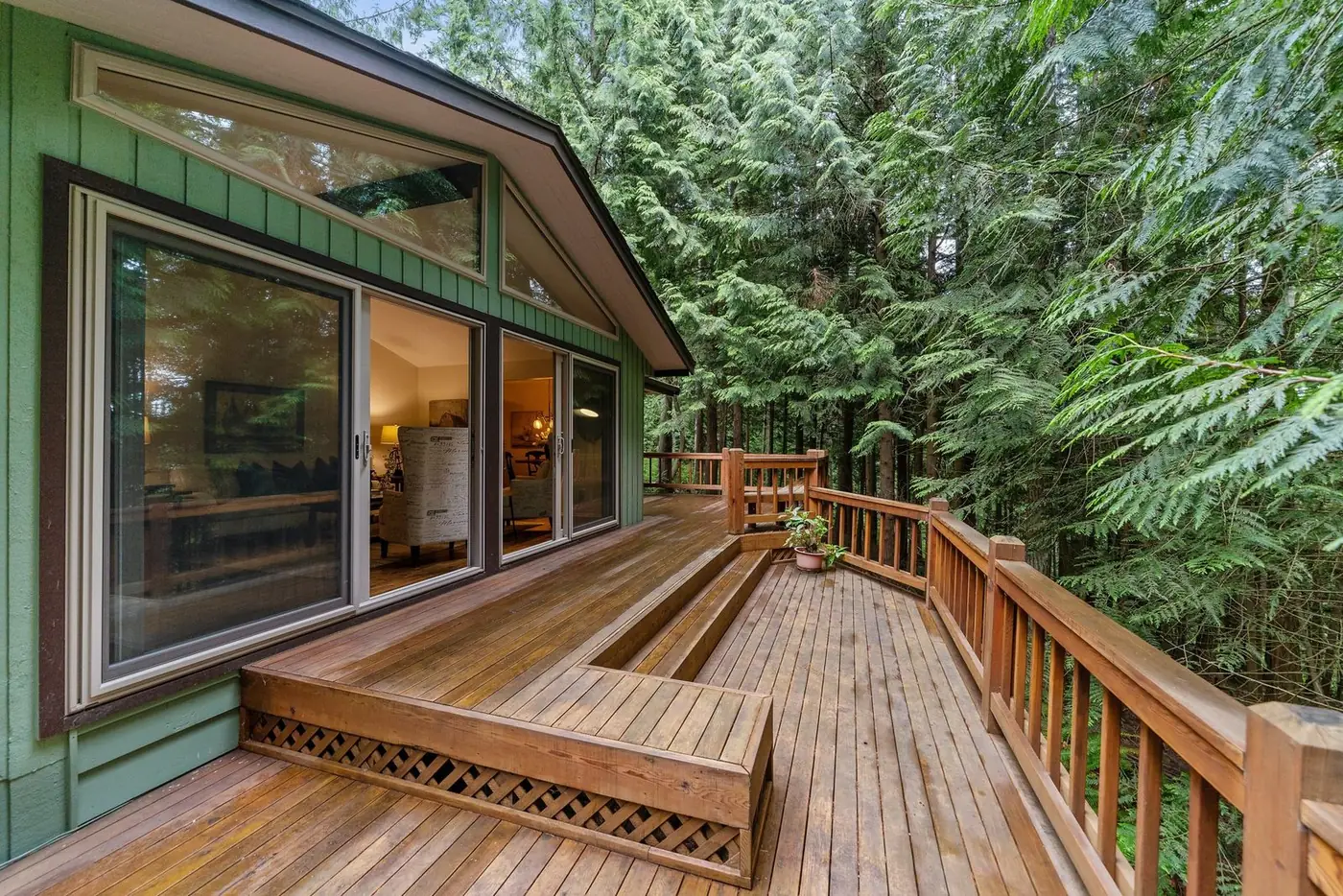
What a 12×16, 16×20 and 20×24 deck costs
Here are three common sizes priced end to end. Each assumes a rectangular deck attached along its long side, about three feet off the ground, with railing on the three open sides (less a 4 ft stair opening), a five-step stair and a permit with drawings. The pressure-treated version uses wood railing and wood stairs. The composite version uses aluminum railing and composite stairs, which is how most composite decks around here are specified.
| Deck size | Area | Railing run | Pressure-treated, all in | Composite, all in |
|---|---|---|---|---|
| 12×16 | 192 sq ft | 36 lin ft | about $9,500–15,800 | about $15,100–24,100 |
| 16×20 | 320 sq ft | 48 lin ft | about $14,400–23,500 | about $23,000–36,300 |
| 20×24 | 480 sq ft | 60 lin ft | about $20,400–33,100 | about $32,600–51,200 |
To show the math on the middle row: a 16×20 pressure-treated deck is 320 sq ft × $35–55, or $11,200–17,600 for the deck. Add 48 ft of wood railing at $35–60 ($1,680–2,880), five wood steps at $250–450 ($1,250–2,250) and a $250–800 permit and plans allowance. In composite, the deck alone is $17,600–27,200, aluminum railing adds $3,360–5,280 and composite steps add $1,750–3,000.
A 12×16 fits a table for four; a 16×20 adds a grill station. At 20×24, splitting the space into two zones or levels usually works better than one big platform. Our multi-level deck ideas guide covers those layouts.
A second-storey deck on a sloped lot
This is the most common North Fulton scenario we price: a 1980s or 1990s house with a walk-out basement, where the kitchen door is eight to ten feet above the backyard. Take a 14×20 composite deck (280 sq ft) that is about 10 ft up at the outside edge.
- Deck surface: 280 sq ft at $55–85 is $15,400–23,800 at ground level. Height adds longer posts, heavier beams, bracing and staging, which we budget at roughly 15–30% on a deck this tall, bringing it to about $17,700–30,900.
- Railing: about 44 lin ft of aluminum at $70–110, or $3,080–4,840.
- Stairs: a 10 ft rise needs about 16 risers to stay under the 7¾ in. maximum riser height, usually with a landing. At $350–600 per composite step, that is $5,600–9,600 before the landing.
- Permit and plans: $250–800.
Total: roughly $26,600–46,200, plus $1,400–2,800 if an old 280 sq ft deck has to come off first. The stair surprises most people: on a tall deck it can cost as much as the railing. The stair stringer calculator will tell you how many risers your height needs.
Railings, stairs, demolition and permits
Railing cost per linear foot
Any deck surface more than 30 inches above grade needs a guard at least 36 inches tall with openings that will not pass a 4 in. sphere. On most decks that means railing on every open side, so the railing style is a real budget decision.
| Railing type | Typical installed cost | Notes |
|---|---|---|
| Wood | $35–60 per lin ft | Cheapest; needs the same finishing as a wood deck |
| Aluminum | $70–110 per lin ft | Powder-coated, low upkeep, accepted by most HOAs |
| Cable | $110–180 per lin ft | Open view; needs stout corner posts to hold tension |
| Glass | $150–250 per lin ft | Clearest view; shows pollen in spring |
On a 48 ft run, wood costs $1,680–2,880 and glass costs $7,200–12,000. The railing calculator counts posts and balusters for your layout, and our railing styles page and railing height code guide cover the options and the rules.
Stairs
Stairs are priced per step for a standard 4 ft wide stair: about $250–450 per step in wood and $350–600 in composite. Wider stairs, landings, built-in lighting and stairs that turn a corner add to that. The code limits (7¾ in. maximum riser, 10 in. minimum tread, a graspable handrail at 34–38 in.) set how many steps a given height needs.
Demolition and haul-away
Taking off an old deck typically costs $5–10 per sq ft, more when the deck is high, hard to reach or has a hot tub or roof attached. That covers tear-off, loading and disposal. Old treated lumber goes to a landfill or transfer station; it should never be burned.
Permits and drawings
Budget about $250–800 for the permit and the drawings that go with it. The fee itself is set by your city or county and varies, and some calculate it from the value of the work. Almost every attached deck in North Fulton needs one; our deck permit guide explains who issues them and what inspections to expect.
Skirting, lighting and finishes
- Skirting around the open sides: about $20–40 per linear foot. See deck skirting ideas.
- Lighting on posts, stairs and risers: about $1,200–3,500 for a package.
- Staining a new wood deck: $2–5 per sq ft, once the wood has dried enough to take stain. The deck stain calculator estimates gallons.
Covered decks, pergolas and screened porches
In Atlanta, sun and mosquitoes decide how many months you use a deck, which is why so many projects add cover.
| Add-on | Typical installed cost |
|---|---|
| Wood pergola | $4,000–12,000 |
| Aluminum louvered pergola | $15,000–40,000+ |
| Screening in an existing covered deck | $15–35 per sq ft |
| New roofed screened porch | $90–180 per sq ft |
A 14×16 screened porch (224 sq ft) built new with a roof typically runs about $20,200–40,300. If you already have a sound covered deck, screening it in costs a fraction of that. The catch is structure: a roof usually needs bigger footings and beams, so if you may want one later, size the framing for it now. Price it with the screened porch cost calculator, and see screened porches, pergolas and covered decks and the covered deck ideas guide.
What drives the price up in North Fulton
National cost guides average out conditions that are not average here. These push a Roswell, Alpharetta, Johns Creek or Sandy Springs deck toward the top of its range.
Slopes and walk-out basements
Many lots fall away from the house. A deck that is three feet up at the door can be nine feet up at the far corner. Taller posts need bigger footings, beams, bracing and staging. Price your deck at the height of its tall side.
Red clay, roots and footings
Georgia’s Piedmont clay bears well once you reach firm native ground, but it is slow digging, and next to older foundations the soil is often loose backfill, so footings go deeper. Big oaks and poplars mean working around roots. The footing calculator shows the concrete involved.
Access
If materials have to be hand-carried down a steep side yard, around a pool or through a gate, labor goes up.
The house wall
The ledger is where older decks fail, so it gets siding off, flashing on and bolts through the house band. Brick veneer cannot carry a ledger, so those decks are built freestanding with an extra beam. Rotten rim joists found during tear-off are a common change order. Our deck ledger board guide explains why.
HOA requirements
Many subdivisions specify materials, colors or railing styles and review plans before the permit. That adds time more than money, but it can rule out the cheapest options.
Tree canopy and moisture
Decks under heavy shade stay damp and grow mildew, so they need ventilation, proper gaps (see deck board spacing) and boards that tolerate moisture. If you are building a deck over a patio you want to keep dry, see under-deck drainage and ceilings.
Composite deck cost vs wood over time
Composite costs roughly 50–60% more than pressure-treated pine at the start. On a 16×20 deck, the decking alone is about $6,400–9,600 more in composite. What you get back is the staining cycle: in Georgia sun and humidity a wood deck needs cleaning and stain every two to three years at about $2–5 per sq ft, or $640–1,600 a round for that deck. Over ten years, three or four rounds close much of the gap. If you are staying put, composite comes close to even; if you might sell soon, pine with fresh stain often makes more sense.
Within composite, the brand matters less than the product line. Our Trex vs TimberTech and composite vs PVC guides compare them, including how hot each gets in full sun. If you are staying with wood, the deck stain colors guide helps you pick a finish that hides pollen and red clay.
Deck repair cost vs deck replacement cost
How much does it cost to replace a deck? Take the new-deck price for your size and material, then add $5–10 per sq ft to remove the old one. Replacing a 16×20 deck in pressure-treated pine comes to roughly $16,000–26,700 all in, and in composite roughly $24,600–39,500. Reusing old footings can trim that, but on older North Fulton decks they are often too shallow or in the wrong place.
Deck repair cost is harder to put a single number on, because it depends entirely on what is wrong. Some useful anchors:
- Replacing a failing stair costs about the same per step as a new one: $250–450 per step in wood.
- Replacing a wobbly or short railing costs about the same per foot as new railing, starting at $35–60 per lin ft in wood.
- Cleaning and re-staining a sound wood deck runs about $2–5 per sq ft. See deck staining and sealing.
- Structural repairs such as sistering joists, adding a beam, re-flashing a ledger or replacing a post on a new footing are priced by the job after an inspection.
A rule of thumb we use: if fixing the structure will cost more than about half of a new deck, or the ledger, footings and many joists all need work, replace it. Our repair-or-replace checklist walks through the signs, and the repair and maintenance and deck replacement pages explain each path.

How to read a deck quote
Two quotes for the same deck often describe different decks. Check each against this list before comparing totals.
- Size and height match on each quote.
- Footings. Number, diameter and depth. “Footings as required” is not a specification.
- Framing. Joist size and spacing, beam size, post size, and whether joist tape or flashing tape is included. Diagonal decking and some composite boards need joists at 12 in. on center.
- Ledger. How it attaches (through-bolts or structural screws, not nails) and how it is flashed. If your house is brick, the quote should say the deck is freestanding.
- Decking. The exact brand and product line, color and fastening method (face screws or hidden fasteners). A picture-frame border costs more and should be listed.
- Railing and stairs. Type, linear feet, number of steps and whether a landing is included.
- Permit, drawings and inspections. Who pulls the permit and who is responsible for passing inspections. It should be the builder.
- Demolition and haul-away, if needed.
- Exclusions. Rotten rim joist repair, tree work and extra footing depth.
- License and insurance. Georgia requires a residential contractor license for most residential work over $2,500. Check it on the Secretary of State’s lookup and ask for a certificate of insurance.
The cheapest quote is often vague on items 2–4, the parts that decide how long a deck lasts. Our deck design process produces the drawings these line items come from.
Price your own deck with our calculators
Every number in this guide uses the same ranges as our free tools:
- Deck cost calculator: your whole deck, line by line.
- Deck board calculator: boards, joists and screws.
- Railing calculator: posts and balusters.
- Stair stringer calculator: risers and treads.
- Joist span calculator: Southern pine spans.
- Footing calculator: concrete for footings.
- Deck stain calculator: stain gallons and cost.
- Screened porch cost calculator.
- Repair-or-replace checklist.
See them all on the tools page. If your deck is in Roswell, Alpharetta, Johns Creek, Milton, Sandy Springs, Marietta or Woodstock, the city pages cover local permits and HOA notes.
Deck cost questions people ask
How much does it cost to build a 12x12 deck in Atlanta?
A 12×12 deck is 144 sq ft, so the deck itself typically runs about $5,000–7,900 in pressure-treated pine or $7,900–12,200 in capped composite. Railing, stairs and the permit usually add a few thousand more, depending on height and railing style.
How much does a composite deck cost per square foot?
Around North Atlanta, a capped composite deck typically costs $55–85 per sq ft installed, including the framing underneath. PVC runs $65–95. Railings, stairs and permits are extra.
How much does it cost to replace a deck?
Replacement costs the same as a new deck of that size and material, plus about $5–10 per sq ft to demolish and haul away the old one. A 16×20 replacement typically comes to $16,000–26,700 in pressure-treated pine or $24,600–39,500 in composite, including railing, stairs and permit.
Does a new deck add value to a house?
A sound, permitted deck is a selling point, and a rotten or unpermitted one is a negotiating point for buyers. Few projects return their full cost at sale, so build the deck for how you will use it, and keep the permit and final inspection paperwork for when you sell.
When is the cheapest time to build a deck in Georgia?
Prices barely change by season, but schedules do. Spring is busiest, so designing and permitting over the mild North Georgia winter gets you building before the rush.
Related pages
Services
Calculators
Guides
Areas we serve
- Deck building in Roswell, Alpharetta, Johns Creek and every North Fulton service area
Stop staring at that tired old deck. Let’s draw something better.
Free in-home consultation. Honest material guidance. A clear, fixed-price quote you can take to the bank — usually within 48 hours of our visit.
Mon–Fri 7a–6p · Sat 8a–4p · Real local crews · No call centers