Deck Board Spacing: How Big a Gap for Wood and Composite
The right deck board spacing depends on the material: wet pressure-treated pine goes down tight or with a very small gap because it shrinks as it dries, kiln-dried lumber gets roughly a 1/8-inch gap, and composite or PVC boards get the side and end gaps their manufacturer specifies, usually set by hidden clips. The goal is a finished gap of about 1/8 to 1/4 inch that drains water and lets debris through without catching heels.
- Wet treated pine: install butt tight or with a nail-width gap. It shrinks across its width as it dries and opens the gap for you.
- Kiln-dried after treatment (KDAT) and dry cedar: gap at the size you want to keep, about 1/8 inch to 3/16 inch.
- Composite and PVC: follow the manufacturer. Side gaps are usually set by hidden clips; end gaps depend on the temperature on install day.
- Joists at 16 inches on center suit most straight runs; diagonal decking usually needs 12 inches.
- In leafy North Atlanta yards, a gap that’s too tight fills with pollen, oak leaves and pine needles and holds water against the framing.
Why deck board spacing matters
The gap between deck boards does four jobs:
- Drainage. Rain needs to fall through, not sit on the surface or run along the boards into the house wall.
- Drying. Air moving through the gaps dries the boards and the tops of the joists. Wood that stays wet rots; composite that stays wet grows mildew.
- Debris. Leaves, pine needles and the yellow coat of spring pollen need somewhere to go. Gaps that are too tight pack full and stop draining.
- Movement. Wood swells and shrinks with moisture. Composite and PVC grow and shrink with temperature. Without room, boards buckle or push against the house.
There’s also an upper limit. Gaps much wider than about 1/4 inch catch high heels and chair legs, swallow small toys and look sloppy. The aim is a consistent finished gap in that 1/8–1/4 inch range once the boards have settled.
Gap between deck boards for drainage in Georgia
Wooded lots are the norm across Roswell, Alpharetta and Johns Creek. A deck under oaks and pines takes a steady load of leaves, needles and seed pods, and in spring a heavy layer of pollen. If the gaps are tight, that debris packs in, stays wet and sits right on top of the joists. On these decks we’d rather err toward the wider end of the range, and we tape the joists underneath. A leaf blower pass after storms helps any deck. If there’s a patio or living space under the deck, keep in mind that gaps let water through by design; our under-deck drainage guide covers how to keep the space below dry.
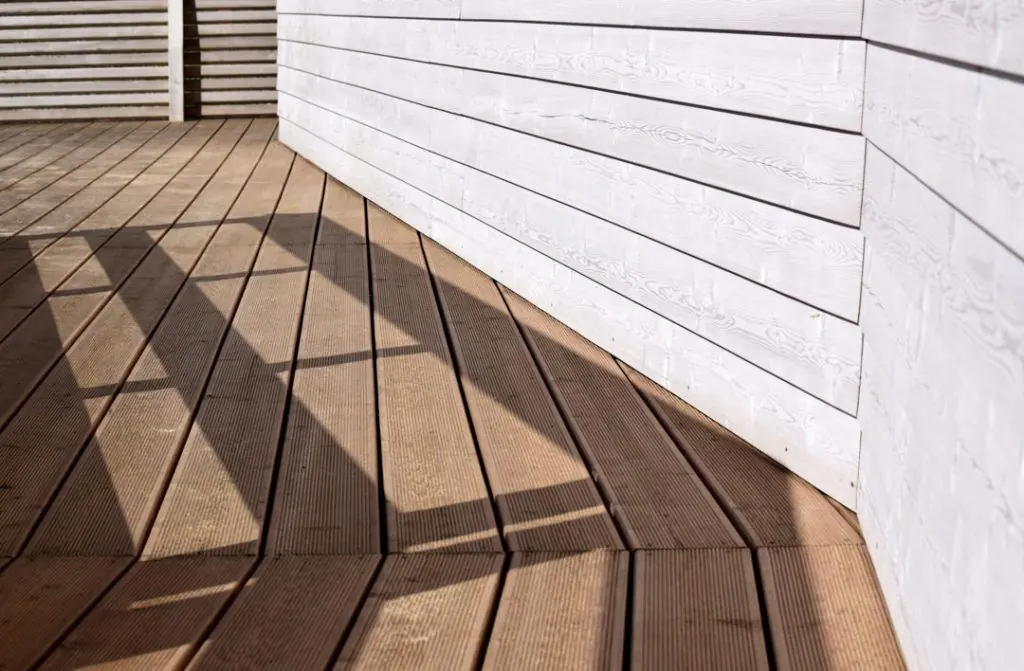
Deck board spacing chart
| Material | Gap at install (side to side) | End joints | Notes |
|---|---|---|---|
| Wet pressure-treated pine | Tight, or about 1/16–1/8 inch | Tight | Shrinks in width as it dries, opening the gap |
| KDAT treated pine | About 1/8–3/16 inch | Tight | Already dry; the gap you set is about the gap you keep |
| Cedar (dry) | About 1/8–3/16 inch | Tight | Check moisture; air-dried stock may still shrink a little |
| Ipe and dense hardwoods | Per supplier, often about 1/8–3/16 inch | Tight, end-sealed | Acclimate on site; follow the hardwood clip system |
| Capped composite | Per manufacturer, usually set by hidden clips | Per manufacturer’s temperature chart | Moves in length with temperature |
| PVC | Per manufacturer, usually set by hidden clips | Per manufacturer’s temperature chart | Generally moves more than composite; follow chart closely |
These are typical starting points, not rules. Lumber moisture varies from load to load, and synthetic products each publish their own requirements.
Pressure-treated deck board spacing
Wet treated pine: butt tight or a small gap
Most pressure-treated southern yellow pine in Georgia lumberyards is sold soon after treatment and is still wet. Pick up a board and you’ll feel it. As it dries over the next few weeks or months, a 5/4×6 deck board loses a noticeable amount of width, often around 1/8 inch or more depending on how wet it started.
So the usual practice is to install wet boards tight together, or with a small spacer such as a 16d nail between them. Once they dry, they open to a gap close to the target range. If you gap wet boards at 1/4 inch, you can end up with gaps closer to 3/8 inch by fall.
A quick way to judge: drive a fingernail into the face of a board or look at the end. If water squeezes out or the board feels cold and heavy, treat it as wet. A moisture meter takes the guesswork out.
Kiln-dried after treatment (KDAT)
KDAT lumber has been dried after treatment, so it won’t shrink much more. Gap it at the size you want to keep, about 1/8 to 3/16 inch. It costs more and isn’t always stocked, but it gives a straighter, more predictable deck and can be stained sooner. For more on lumber choices, see the best wood for decks guide.
End joints and the house wall
Wood barely changes length with moisture, so butt joints in wood decking go tight, landed over a joist (or doubled blocking) with each end fastened. Stagger joints across the deck so they don’t line up. Where boards meet the house, leave a small gap so water can drain rather than being trapped against the siding and ledger flashing.
Composite deck board spacing
Composite and PVC boards don’t shrink as they dry, but they do change length with temperature, which is why their spacing rules are different and why the manufacturer’s installation guide is the final word.
Side gaps
Most grooved composite and PVC boards are installed with hidden clips that sit in the groove between boards. The clip sets the side gap automatically, typically somewhere around 3/16 to 1/4 inch depending on the system. That’s one reason to use the manufacturer’s clips: the gap, the hold-down and the warranty requirements line up.
End gaps by temperature
Synthetic boards get longer in heat and shorter in cold. Manufacturers publish a small chart that tells you how big a gap to leave at butt joints and where boards meet the house, posts or another board, based on the temperature when you install. On a hot July day the boards are already expanded, so the gap is smaller; on a cold January morning the gap is larger so the boards can grow in summer. Georgia’s swing from winter mornings below freezing to summer decks too hot to touch makes this matter. Boards stored in the sun and boards stored in the shade can also be at different temperatures on the same day, so let them acclimate together.
Picture-frame borders
A border of boards running around the edge of the deck hides cut ends, gives the end-gaps somewhere neat to land, and lets you break up long runs with a divider board instead of butt joints. It takes more material and blocking but makes a composite deck look finished.
Airflow under the deck
Many composite and PVC manufacturers specify a minimum clearance or ventilation under the deck, especially for low decks. On a ground-level deck over damp red clay, that matters as much as the gap between boards. For the differences between materials, see composite vs PVC decking and Trex vs TimberTech.
Joist spacing: 16 inch vs 12 inch
Board spacing and joist spacing go together. Boards that span too far between joists bounce, sag and, with synthetic boards, can develop a wavy look over time.
Straight (perpendicular) decking
For 5/4 wood decking and most composite and PVC boards, joists at 16 inches on center is the standard. The IRC’s decking table allows thicker 2× wood decking to span wider, but most decks around here use 5/4 boards. Some synthetic lines allow other spans, so check the installation guide for the product you’re using.
Diagonal decking
Running boards at an angle across the joists makes each board span farther than the on-center spacing. For diagonal layouts, 12 inches on center is typical for 5/4 wood and most composites. If you want a herringbone or diagonal design, decide before framing, because adding joists afterward is a big job.
Breaker boards and blocking
Patterns with breaker boards, borders or herringbone need extra joists or blocking under every joint so each board end lands on solid framing. Plan these in the framing drawing. Check your joist sizes with the joist span calculator, and confirm the code edition your city uses with your permit office.
Hidden fasteners and spacers
Hidden clips
Hidden fastener systems hold grooved boards with a clip screwed into the joist between each pair of boards. They leave a clean, screw-free surface and set the gap for you. The first and last boards usually need face screws or a starter clip, and stairs and borders may need face fastening or plugs. Use stainless steel or coated fasteners rated for your decking and for treated lumber.
Face screws and plugs
Square-edge boards get two screws at every joist, set about 3/4 inch in from each edge. Color-matched plug systems let you face-screw composite or wood and then hide the screw head. With face fastening, you set the gap with spacers: a 16d nail, a carpenter’s pencil, or purpose-made plastic spacers, pulled out once the board is fastened.
Keep it consistent
Every few rows, measure from the house to the board edge at both ends and in the middle. Small variations add up across a 16-foot deck and leave the last board tapered. Adjusting a hair at a time across several rows hides the correction.
Laying out an even deck
Spacing affects how many boards you need. A nominal 6-inch board is about 5-1/2 inches wide. With a 1/8-inch gap, each row covers about 5-5/8 inches; across a 16-foot (192-inch) deck that’s a little over 34 rows, so you’d plan on 35 and rip the last board if needed. With a 3/16-inch composite gap, each row covers about 5-11/16 inches, a little under 34 rows. A ripped last board looks better when it’s at least half width, so many installers plan the layout from both edges before the first board goes down.
Our deck board calculator does this math for you, including gaps, waste, joists and screws. To estimate the whole project, use the deck cost calculator. If you’d rather leave the layout to a crew, see our custom decks and composite decks pages, or deck replacement if you’re re-decking an old frame.
Questions about deck board gaps
How far apart should deck boards be?
Aim for a finished gap of about 1/8 to 1/4 inch. Wet treated pine is installed tight or nearly tight because it shrinks; kiln-dried wood gets about 1/8 to 3/16 inch; composite and PVC get whatever their manufacturer specifies, usually set by the hidden clips.
Should pressure-treated deck boards be butted tight?
If the boards are wet, yes, or with a very small gap such as a nail width. They shrink in width as they dry and open up a gap on their own. If the boards are kiln-dried after treatment, leave the gap you want to keep.
What is the spacing for composite deck boards?
Side gaps are usually set by the manufacturer’s hidden clips, commonly around 3/16 to 1/4 inch. End gaps at butt joints and where boards meet the house depend on the temperature on install day; use the chart in the manufacturer’s installation guide.
Do deck joists need to be 12 inches apart for composite?
For straight runs, most composite boards are rated for 16 inches on center. For diagonal layouts, 12 inches on center is typical. Some products differ, so check the installation guide for your specific board before framing.
Why are my deck board gaps getting bigger?
On a wood deck, the boards are drying and shrinking, which is normal in the first year with wet treated lumber. Gaps also open slightly in dry weather and close in humid weather. On composite, end gaps change with temperature. Gaps that keep growing alongside loose or cupped boards can point to fastener or framing problems worth a closer look.
Related pages
Services
Calculators
Guides
Areas we serve
- Deck building in Roswell, Alpharetta, Johns Creek and every North Fulton service area
Stop staring at that tired old deck. Let’s draw something better.
Free in-home consultation. Honest material guidance. A clear, fixed-price quote you can take to the bank — usually within 48 hours of our visit.
Mon–Fri 7a–6p · Sat 8a–4p · Real local crews · No call centers