Deck Stain vs Paint: Which Is Better for Your Deck?
In the deck stain vs paint decision, stain is the better choice for most open deck floors: it soaks into the wood, lets moisture escape and wears by fading, so recoating is a quick clean-and-reapply job. Paint forms a hard film that looks great at first but traps moisture, wears through in traffic lanes and peels, and fixing a peeling painted deck means scraping and sanding. Paint earns its place on railings, trim and covered porch floors.
- Penetrating stain fades; paint and other film finishes peel. On a surface you walk on, fading is far easier to maintain.
- Solid stain sits between the two: more color and life than semi-transparent stain, a thinner and more breathable film than paint, but it can still peel.
- Paint works well on vertical parts (rails, balusters, fascia, skirting) and on roofed porch floors that rarely get soaked.
- Thick “resurfacer” coatings promise to rescue worn decks, but on boards that are cracked, soft or damp they often fail and are hard to remove.
- Once a deck is painted, going back to stain means stripping or sanding to bare wood, or replacing boards.
How deck stain and paint differ
The difference is where the finish lives. A penetrating stain is mostly absorbed into the top layer of the wood. Its pigment and oils or resins sit in the wood fibers, not on top of them. Paint, by contrast, is designed to build a continuous film over the surface, with a primer underneath to help it grip.
That one fact explains almost everything about how each behaves on a deck:
- Moisture. Deck boards get wet from above through rain and from below through humid air and damp ground. Penetrating stain lets that moisture move in and out. A paint film slows it down, so water that gets in through a crack, end grain or the underside can push the film off from behind.
- Movement. Wood swells and shrinks with every wet and dry spell. A thin penetrating finish moves with it; a rigid film eventually cracks, especially at board ends and around fasteners.
- Wear. Feet, chairs and grit scuff a deck floor constantly. On stain, wear shows as gradual fading. On paint, it shows as worn-through patches and flakes that need scraping before the next coat.
Deck stain vs paint compared
| Semi-transparent stain | Solid stain | Deck or porch paint | |
|---|---|---|---|
| Wood grain | Visible | Texture only | Hidden |
| Color choice | Wood tones | Wide | Widest |
| How it fails | Fades | Wears through, can peel | Cracks, peels, flakes |
| Typical recoat on a sunny Georgia deck floor | About 2 years | About 3–4 years | Varies; traffic lanes often wear within a few years |
| Recoat prep | Clean, brighten, reapply | Clean, scrape loose areas, reapply | Scrape, sand, spot-prime, repaint |
| Slip resistance | Wood texture | Fairly smooth | Can be slick when wet unless textured |
| Hides old or mismatched boards | No | Yes | Yes |
| Reversible | Easy | Hard | Very hard |
Recoat intervals are rules of thumb for horizontal surfaces in full sun. Vertical surfaces and shaded or covered areas last longer with any finish.
When deck paint makes sense
Paint isn’t the wrong answer everywhere. It’s the right one in places where its strengths matter and its weaknesses don’t.
Railings, balusters and trim
Vertical surfaces shed water and don’t take foot traffic, so a good exterior paint lasts much longer on them than on a floor. White painted rails over a stained floor is a classic look on Southern homes, and it pairs well with white house trim. Use an exterior primer suited to the wood, then a quality exterior paint.
Covered porch floors
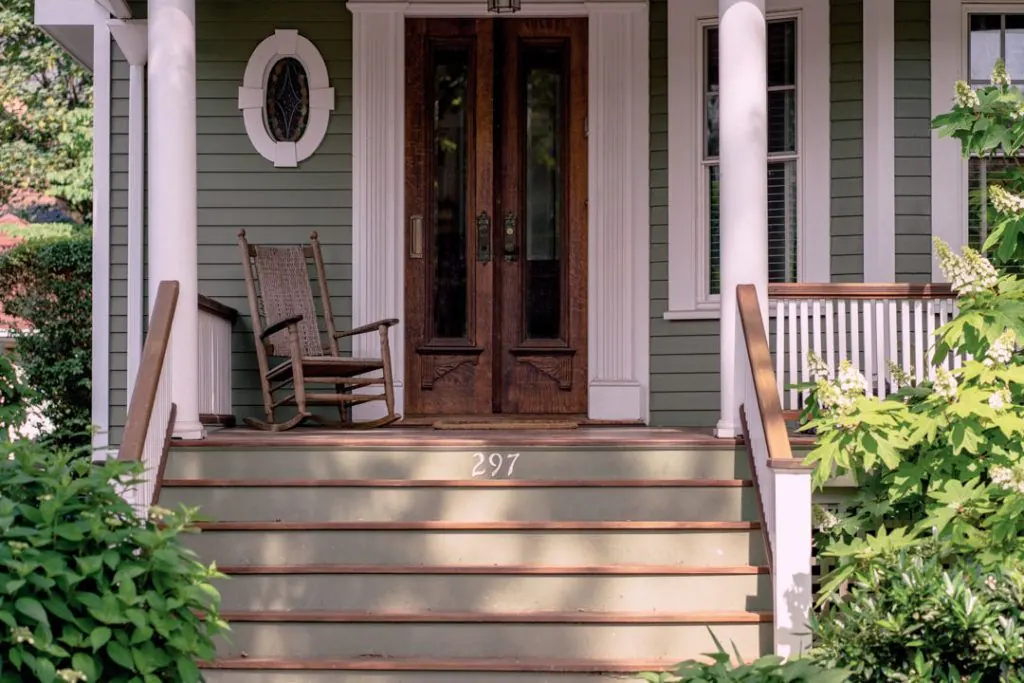
A traditional front porch with tight tongue-and-groove flooring under a roof is a different situation from an open deck. It stays mostly dry, sees little direct sun, and painted porch floors are a long tradition across Georgia. A porch and floor enamel made for foot traffic works well here. If you’re adding a roof over a deck, see our covered deck ideas.
Fascia, skirting and stair stringers
Fascia boards, lattice and skirting are good candidates for paint or solid stain, often in a color that matches the house trim. Our deck skirting ideas show how that ties a deck to the house.
When paint is a poor fit
- Open deck floors in full sun and rain.
- New pressure-treated lumber that hasn’t fully dried. Paint over wet treated pine is one of the most common causes of early peeling.
- Older decks with cupped, checked or weathered boards, where water gets under the film through every crack.
- Composite or PVC decking. Most manufacturers don’t recommend painting their boards.
Solid stain vs paint
Solid stain looks a lot like paint once it’s on, and many are acrylic-based, so people reasonably ask what the difference is. In practice:
- Thinner film. Solid stain is formulated to soak in somewhat before building a thin film, rather than sitting entirely on top. It generally lets the wood breathe better than paint.
- Made for decks. Deck-specific solid stains are formulated for horizontal surfaces and foot traffic. Many paints are not.
- Texture shows. Solid stain lets some wood texture through; paint tends to bury it.
- Still a film. Solid stain can peel too, and it can’t easily go back to a see-through look.
If you want an opaque, painted look on a deck floor, a deck-rated solid stain is usually the better choice than paint. A common combination is semi-transparent stain on the floor and solid stain or paint on rails, fascia and skirting. For help choosing a stain type and product, see our best deck stain guide, and for colors, the deck stain colors guide.
Deck restoration coatings and resurfacers
Home centers sell thick, paint-like deck coatings marketed as resurfacers or restoration coatings. They go on heavily, often with a textured finish, and promise to fill cracks, hide splinters and give an old deck a new surface.
They can look good at first. The trouble is that they’re still a film, just a thicker one, sitting on wood that is usually old, checked and moving. When water gets under the coating through cracks, end grain or the underside, it can blister and peel in sheets, and the thick product is very hard to strip. Some owners end up replacing boards they could have simply restained.
If you’re considering one, read the label’s prep requirements carefully and test a small area first. Our general advice: if the boards are sound enough for a resurfacer to stick well, they’re usually sound enough for a solid stain. If they’re soft, split or cupped, new boards over the existing frame will last far longer than any coating. That’s what our deck resurfacing service does: replace the walking surface (and any weak framing) while keeping a sound structure.
Fixing a peeling painted or stained deck
Peeling is the most common problem with painted decks and solid-stained floors. Your options, from least to most work:
Spot repair
If peeling is limited to a few traffic lanes or a sunny edge, scrape loose areas, sand the edges smooth, clean, spot-prime bare wood and recoat. The patches may show for a while.
Strip and restart
For widespread peeling, a chemical stripper and pressure wash can remove much of the film, followed by sanding. This is slow and messy, especially on thick coatings, but it gets you back to bare wood so you can switch to a penetrating stain.
Flip or replace boards
On some decks, flipping sound boards so the unpainted side faces up is an option; on others, replacing the decking is faster than stripping and gives a better result. Old boards that are already cupped or checked are often not worth the stripping labor.
Prevent it next time
- Let treated lumber dry fully before any finish. The water-sprinkle test helps: if water soaks in, the wood is ready.
- Clean and dry the deck properly before coating. Dirt, mildew and moisture all break the bond.
- Apply thin coats. Heavy coats of film-forming finishes are more prone to peeling.
- Keep gutters, downspouts and sprinklers from soaking the deck, and keep leaves off it.
Our deck staining and sealing service includes stripping, cleaning and brightening when needed. Professional staining in our area typically runs $2–5 per square foot depending on condition and prep. To estimate materials, try the deck stain calculator.
Maintenance cycles in Georgia
North Atlanta’s climate is hard on film finishes. A few local factors to weigh:
- Humidity and summer storms. Frequent wetting and drying is exactly what pushes a film off wood. Decks over damp ground or with little airflow underneath see it most.
- Sun on south and west exposures. UV breaks down every finish; heat makes dark paint and solid stain hot underfoot and speeds up cracking.
- Mildew on shaded decks. Painted surfaces under tree canopy can grow mildew; look for products with mildewcide and clean the deck once or twice a year.
- Pollen and red clay. Light paint colors show spring pollen and clay footprints quickly, which means more washing and more wear on the film.
A realistic plan for a typical sunny treated-pine deck around Roswell or Alpharetta: clean every year, recoat a semi-transparent floor about every two years, and refresh painted or solid-stained rails every few years. That rhythm keeps the wood protected and avoids the big strip-and-sand jobs. For a wider look at how finishes affect lifespan, see how long does a deck last.
Questions about deck stain and paint
Is it better to paint or stain a deck?
For an open deck floor, stain is usually better. It soaks in, lets moisture escape and fades instead of peeling, so maintenance is simple. Paint works well on railings, trim and covered porch floors.
Does deck paint last longer than stain?
On vertical surfaces it often does. On a deck floor in sun and rain, paint frequently wears through in traffic lanes and peels within a few years, and the prep to repaint is much heavier. A semi-transparent stain needs recoating more often, but each recoat is quick.
Is solid stain the same as paint?
No. Solid stain is opaque like paint, but it forms a thinner film, lets some wood texture show and is formulated for decks. It still can peel, but it’s generally a better choice than paint for an opaque deck floor.
Can you stain over a painted deck?
Not with a penetrating stain; it can’t soak through paint. You’d need to strip or sand back to bare wood first. A solid stain or new paint can go over sound, well-bonded paint after cleaning and scuff-sanding.
Do deck resurfacer coatings work?
Results are mixed. On sound, dry, well-prepared boards they can look good, but on cracked, soft or damp wood they often blister and peel and are hard to remove. If boards are that worn, replacing the decking usually lasts longer.
Related pages
Services
Calculators
Guides
Areas we serve
- Deck building in Roswell, Alpharetta, Johns Creek and every North Fulton service area
Stop staring at that tired old deck. Let’s draw something better.
Free in-home consultation. Honest material guidance. A clear, fixed-price quote you can take to the bank — usually within 48 hours of our visit.
Mon–Fri 7a–6p · Sat 8a–4p · Real local crews · No call centers